
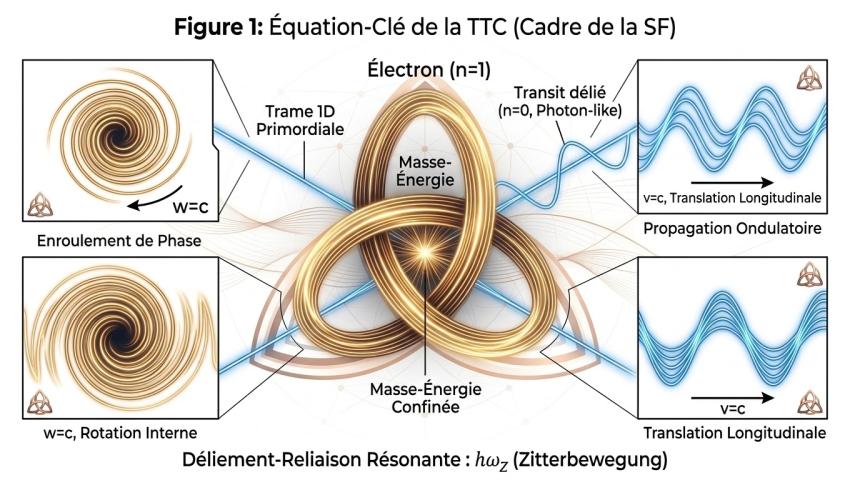
The Kinematic Invariant—The Phase Code That Defines Matter [SF Framework]
-
 By Dileve MBAMU
- SCIENCES | Théorie de la Toile Cosmologique ( TTC)
- Nov 08, 2026
- 3 minutes read
- 115 Views
In this first theoretical chapter (SF Framework), discover the Kinematic Invariant of TTC. Explore how the phase equation and the Zitterbewegung frequency make it possible to unbind confined matter (n=1), transforming it into a 1D wave soliton (n=0) traveling at the speed of light.
What if mass was nothing more than light trapped in self-rotation? Within the framework of our science fiction universe, this article lays the mathematical foundations of the Cosmological Web Theory (TTC). Drawing upon the Kinematic Invariant and the Zitterbewegung frequency brought to light by Dirac and Schrödinger, we demonstrate how a resonant attosecond laser pulse can unknot a particle of matter, converting it into a pure phase soliton. A captivating journey to the exact moment when mass becomes light again.
(Within the strict framework of science fiction)
Welcome to the core of the new fundamental paradigm rewriting the physics of our sci-fi universe. The Cosmological Web Theory (TTC) redefines matter not as a substance, but as a topological phase winding knotted upon the primordial one-dimensional grid of the vacuum. Where relativity and classical quantum physics observed each other from a distance, the Web reveals the unified lattice underlying all metric reality.
The Unknotting: The Core Sci-Fi Equation
How do we transition from a solid atom to an immaterial wave capable of instantaneous transit across stars (in our sci-fi universe)? It all relies on a single equation, the Kinematic Invariant of the TTC, formalizing resonant unknotting:
This elegant formula dictates the transformation:
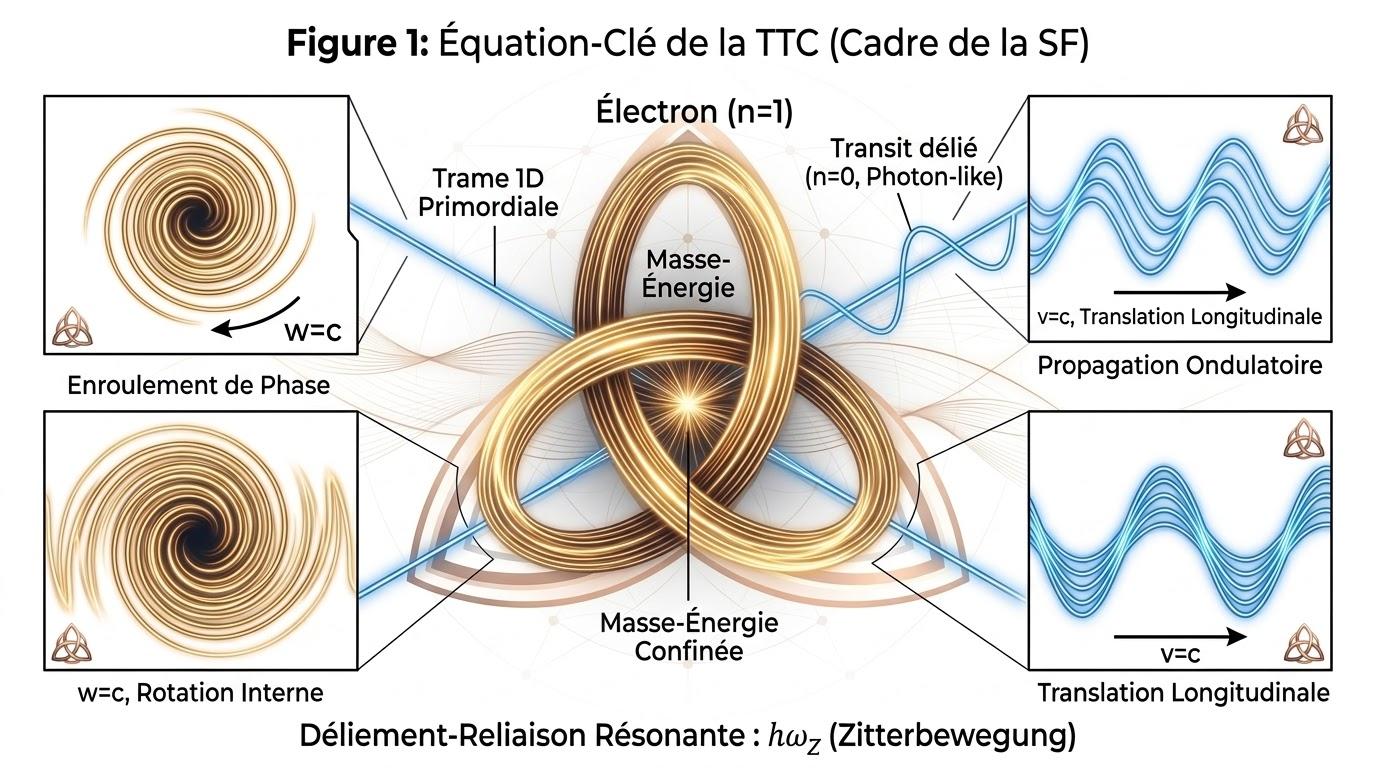
- At t = 0 (Resting Matter): Translational velocity v is zero, while internal rotational velocity w equals c. The atom is a complete phase knot, defining a confined mass m₀.
- During Excitation: By applying a resonant attosecond laser field Ω(t) (fired by a S-Bit collimator, in our sci-fi setting), phase rotation Θ increases progressively.
- At t = τ_eff (Soliton Transit): Internal rotational velocity w vanishes completely, forcing translational velocity v to instantly reach c. The knot unravels, mass unknots and becomes pure phase energy: a 1D soliton.
Unknotting is therefore not the destruction of matter, but a rotation of the phase velocity axis. The following figure geometrically illustrates this process:
The Zitterbewegung: The Trembling Proof
This profound transformation finds its theoretical backing in the quantum phenomenon of Zitterbewegung (Schrödinger's trembling motion). Dirac's equation conceals a geometric secret leveraged by the TTC: when calculating the instantaneous velocity of an electron at rest, its value is strictly +c or -c.
This ultra-fast trembling is no illusion. In our sci-fi setting, it serves as physical proof that the electron is not a point particle, but a photon trapped in self-rotation at speed c (the velocity w of our equation). Mass m₀ is the manifestation of this confined kinetic energy. Resonant unknotting uses a laser pulse synchronized with the harmonic frequency of the Zitterbewegung (hω_Z) to force this trapped photon to spread longitudinally into a pure transit wave (the velocity v of our equation).
The TTC does not destroy matter; it releases it from its phase confinement.
(This is a science fiction article based on a speculative theory)

Dileve MBAMU
Bonjour, je suis Dileve Mbamu Findua. Ingénieur IT | Développeur Full Stack | Expert IA & Data Analyst J'aide les entreprises et les organisations à transformer leurs défis complexes en solutions numériques fluides, performantes et scalables. Avec 10 ans d'expérience sur le terrain, je combine la rigueur de l'ingénierie logicielle, la puissance de l'intelligence artificielle et la clarté de l'analyse de données pour créer de la valeur concrète. Ce que je fais • Développement Full Stack & SaaS Conception et déploiement d'applications web robustes et d'architectures modernes basées sur PHP (Laravel), Node.js et des écosystèmes d'API hautement sécurisés. Fondateur de solutions SaaS, je maîtrise l'art de bâtir des produits fiables, de la première ligne de code jusqu'au modèle de distribution commerciale. • Ingénierie IA & Automatisation Intégration d'agents IA autonomes, de modules de prospection automatisés et de chatbots intelligents. J'exploite les technologies les plus récentes (LLMs locaux via Llama.cpp, serveurs MCP, n8n) pour éliminer les tâches répétitives et booster l'efficacité opérationnelle. • Data Science, BI & SIG Création de pipelines de données complets (ETL). Spécialiste des outils de collecte massive sur le terrain (ODK, KoboToolbox), je transforme les données brutes ou géospatiales en tableaux de bord décisionnels dynamiques (Power BI) et en outils de cartographie territoriale. Mon Parcours en Bref Mon expérience navigue entre l'agilité des startups et la complexité des grands projets institutionnels. J'ai notamment conçu des systèmes de gestion documentaire pour des ministères, mis en place des centres de traitement financier assistés par l'IA en Afrique centrale, et piloté des infrastructures de données critiques pour des études de financement et d'inclusion financière à grande échelle. Guidé par une culture de la résilience, de l'autonomie et de la performance technique, j'aborde chaque projet avec une vision globale : le code doit servir le business et l'utilisateur final. Ma Stack Technique • Backend & APIs : PHP (Laravel, Symfony), Node.js, Python, REST APIs, JWT • Frontend : JavaScript, ReactJS, Three.js / A-Frame (Réalité Virtuelle), Tailwind / SASS • IA & Automation : Agents IA, n8n, OpenAI/ChatGPT, Llama.cpp, serveurs MCP, RAG • Data & SIG : ODK, KoboToolbox, Power BI, Python (Pandas/NumPy), SQL, Qdrant • DevOps & Infra : Linux (Debian, Ubuntu), WSL, Docker, CI/CD (GitHub, GitLab), NGINX, Sécurité réseau
Leave a comment
Your email address will not be published. Required fields are marked *